Published page
Adolf Hitler

Adolf Hitler (April 20, 1889 – April 30, 1945) was an Austrian-born German politician who served as the dictator of Germany from 1933 until his death in 1945.
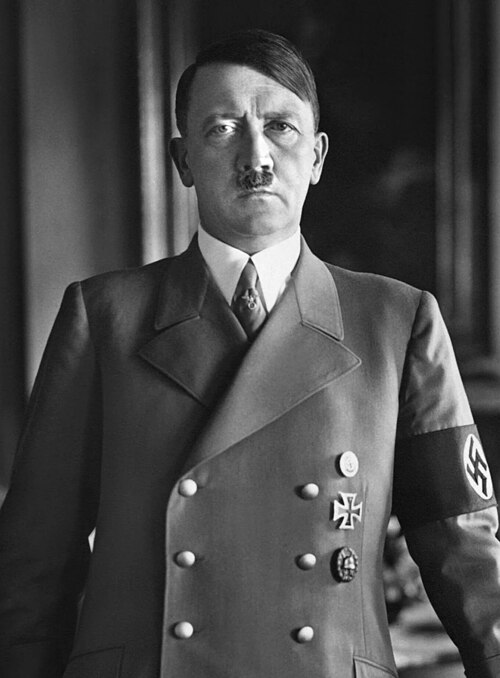
Adolf Hitler
Adolf Hitler (April 20, 1889 – April 30, 1945) was an Austrian-born German politician who served as the dictator of Germany from 1933 until his death in 1945.
Heinrich Hoffmann · CC BY-SA 3.0 de · Hitler portrait crop (cropped)(2).jpg
1. Adolf Hitler
Adolf Hitler (April 20, 1889 – April 30, 1945) was an Austrian-born German politician who served as the dictator of Germany from 1933 until his death in 1945.
He rose to power as the leader of the National Socialist German Workers' Party (NSDAP), commonly known as the Nazi Party, establishing a totalitarian regime characterized by aggressive expansionism, virulent antisemitism, and the absolute suppression of political opposition. His aggressive foreign policy initiated World War II in Europe, and his racial ideologies led to the systematic genocide of six million Jews and millions of other victims in the Holocaust.
1.1 Early Life and Rise to Power
Born in Braunau am Inn, Austria-Hungary, Hitler spent his youth harboring frustrated artistic ambitions in Vienna and Munich. The outbreak of World War I provided him with a sense of purpose; he enlisted in the Bavarian Army, serving as a dispatch runner and earning the Iron Cross for bravery.
The trauma of Germany's defeat in 1918 and the subsequent economic devastation of the Weimar Republic fueled his radicalization. Joining the fledgling German Workers' Party in 1919, his charismatic and venomous oratorical skills quickly propelled him to its leadership. Following a failed coup attempt in 1923 known as the Beer Hall Putsch, Hitler used his brief imprisonment to dictate his ideological manifesto, *Mein Kampf* (My Struggle).
Capitalizing on the Great Depression, democratic instability, and intense anti-communist sentiment, Hitler positioned the Nazi Party as the sole savior of the German nation. Through a combination of electoral success, political intrigue, and street violence orchestrated by his paramilitary wing, he was appointed Chancellor on January 30, 1933.
1.2 The Nazi Regime and Dictatorship
Upon securing the Chancellorship, Hitler moved swiftly to dismantle Germany's democratic institutions. The Reichstag fire of February 1933 served as the pretext for suspending civil liberties, followed by the passage of the Enabling Act, which granted his cabinet legislative powers independent of the parliament.
By consolidating the offices of Chancellor and President after the death of Paul von Hindenburg in 1934, Hitler declared himself *Führer und Reichskanzler* (Leader and Chancellor of the Reich). Under the banner of the Third Reich, the state was rapidly aligned with Nazi ideology through a process known as *Gleichschaltung* (coordination).
The regime implemented aggressive economic policies that initially succeeded in lowering unemployment, largely through rapid rearmament and public works. Simultaneously, state-sponsored terror was institutionalized through the Gestapo and the SS, while propaganda under Joseph Goebbels systematically brainwashed the public.
1.3 World War II and the Holocaust
Hitler's ultimate foreign policy objective was the acquisition of *Lebensraum* (living space) for the Germanic peoples in Eastern Europe, necessitating the destruction of the Soviet Union. His aggressive territorial demands—including the annexation of Austria and parts of Czechoslovakia—were initially met with appeasement by Western powers.
The invasion of Poland on September 1, 1939, finally triggered World War II. Utilizing the revolutionary *Blitzkrieg* (lightning war) tactics, German forces rapidly conquered most of mainland Europe. However, the fateful decision to invade the Soviet Union in 1941 and the subsequent entry of the United States into the conflict marked the turning point of the war.
Parallel to the military campaigns, Hitler orchestrated the Holocaust (referred to by the regime as the "Final Solution to the Jewish Question"). This state-sponsored, bureaucratic program resulted in the industrial-scale murder of approximately six million European Jews, alongside millions of Romani people, Soviet prisoners of war, political dissidents, Jehovah's Witnesses, and disabled individuals in specialized extermination camps.
1.4 Death and Legacy
By 1945, Germany lay in ruins as Allied forces advanced from the west and the Soviet Red Army closed in from the east. Refusing to surrender, Hitler retreated to the *Führerbunker*, an underground bunker complex beneath the Reich Chancellery in Berlin.
On April 30, 1945, as Soviet troops fought their way through the streets of Berlin, Hitler committed suicide alongside his newly wedded wife, Eva Braun, to avoid capture. His body was subsequently burned in accordance with his instructions.
Hitler's legacy remains one of the darkest chapters in human history. He is universally regarded as one of the most destructive and reviled dictators of the modern era, whose actions led to the deaths of tens of millions of people and the redrawing of the global geopolitical landscape.
2. Trivia
2.1 The Linz Opera House Blueprint
During his youth in Vienna and Linz, Hitler developed an intense obsession with the operas of Richard Wagner, particularly *Rienzi*. This obsession transcended mere appreciation; he drafted meticulous architectural plans for a complete reconstruction of the Linz Opera House. Decades later, during the height of World War II, he ordered state architects to realize these youth sketches, prioritizing the cultural remodeling of his hometown of Linz (intended to become the cultural capital of the Reich) even as military logistics deteriorated.
2.2 The Vegetarianism Paradox and Animal Welfare Legislation
While presiding over a regime responsible for unprecedented human devastation, Hitler adhered to a strict vegetarian diet in his later years, driven by chronic flatulence, indigestion, and a belief in the health doctrines of Richard Wagner. This personal lifestyle translated into state policy; the Third Reich enacted some of the most stringent animal welfare laws of the 20th century, including bans on commercial animal trapping, severe restrictions on vivisection, and regulated methods for humane slaughter.
2.3 The Iron Cross First Class Recommendation
Despite rising to the rank of only *Gefreiter* (lance corporal) during World War I, Hitler wore the prestigious Iron Cross First Class until his death. Paradoxically, the officer who recommended him for this high honor in 1918 was Lieutenant Hugo Gutmann, a Jewish-German adjutant. When the Nuremberg Laws were later enacted, Gutmann was stripped of his citizenship, though he survived the regime due to interventions that some historians attribute to his past association with the dictator.
2.4 The Maybach and Mercedes-Benz Acquisition Ban
Despite his association with the German automotive renaissance—most notably the state-sponsored development of the Volkswagen Beetle—Hitler did not know how to drive. He never obtained a driver's license, relying instead on his personal chauffeur, Julius Schreck, and later Erich Kempka. His preference for luxury vehicles, specifically custom-built, armored Mercedes-Benz 770Ks, was financed largely by the royalties he received from the state's mandatory distribution of *Mein Kampf* to newlyweds and soldiers.
2.5 The Nobel Peace Prize Nomination of 1939
In January 1939, Erik Gottfrid Christian Brandt, a member of the Swedish parliament, nominated Hitler for the Nobel Peace Prize. Though intended as a satirical protest against the Munich Agreement and the appeasement policies of Neville Chamberlain, the nomination was not widely understood as satire. It sparked immediate outrage and was officially withdrawn by Brandt a few days later, just months before the German invasion of Poland initiated World War II.
2.6 The Karl May Literary Obsession
Throughout his life, Hitler maintained a profound fascination with the adventure novels of Karl May, a German author who wrote highly romanticized stories about the American Old West featuring the fictional Native American chief Winnetou. Hitler possessed the complete works of May, frequently quoted them to his generals during military briefings, and even ordered the distribution of May's novels to German soldiers on the Eastern Front to boost morale and tactical imagination.
Child documents of "Adolf Hitler"
None yet.