Published page
Joseph Stalin

Iosif Vissarionovich Stalin (born Ioseb Besarionis dze Jughashvili; December 18, 1878 – March 5, 1953) was a Georgian-born revolutionary and Soviet politician who led the Sovi…
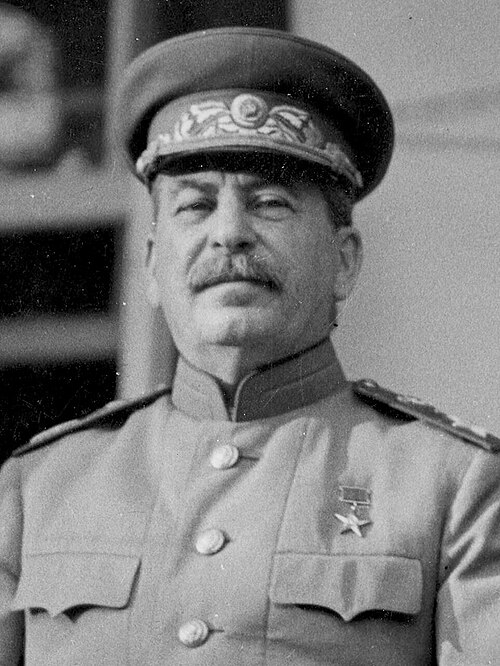
Joseph Stalin
Iosif Vissarionovich Stalin (born Ioseb Besarionis dze Jughashvili; December 18, 1878 – March 5, 1953) was a Georgian-born revolutionary and Soviet politician who led the Sovi…
Franklin D. Roosevelt Library Public Domain Photographs · Public domain · StalinCropped1943.jpg
1. Joseph Stalin
Iosif Vissarionovich Stalin (born Ioseb Besarionis dze Jughashvili; December 18, 1878 – March 5, 1953) was a Georgian-born revolutionary and Soviet politician who led the Soviet Union from the mid-1920s until his death in 1953.
He served as the General Secretary of the Communist Party of the Soviet Union (1922–1952) and Chairman of the Council of Ministers of the Soviet Union (1941–1953). Initially governing the country as part of a collective leadership, he eventually consolidated power to become the de facto dictator of the Soviet Union by the 1930s. Stalin's state-led industrialization and victory over Nazi Germany transformed the USSR into a global superpower, though this was achieved at the cost of immense human suffering, mass repression, and totalitarian control.
1.1 Early Life and Revolutionary Activities
Stalin was born in the town of Gori, Georgia, then part of the Tiflis Governorate of the Russian Empire. Growing up in a poor household with an abusive father, he was originally steered toward the priesthood by his mother and attended the Tbilisi Spiritual Seminary. However, he abandoned his religious studies after discovering the writings of Karl Marx and subsequently joined the Russian Social Democratic Labour Party (RSDLP).
Adopting the nom de guerre "Stalin" (meaning "Man of Steel"), he became an active underground operative for the Bolshevik faction led by Vladimir Lenin. He engaged in various illegal activities, including bank robberies, kidnappings, and extortion, to fund the party's revolutionary endeavors. These activities led to multiple arrests and exiles to Siberia, from which he repeatedly escaped.
1.2 Rise to Power
Following the February Revolution of 1917, Stalin returned to Petrograd and played a key role in the October Revolution that brought the Bolsheviks to power. During the Russian Civil War, he served as a political commissar and military commander, establishing a reputation for ruthlessness and administrative efficiency.
In 1922, Stalin was appointed General Secretary of the Communist Party, a post that was initially seen as a mundane administrative role. However, Stalin strategically used this position to control party appointments and build a loyal base of supporters. Following Lenin's death in 1924, Stalin outmaneuvered his political rivals—most notably Leon Trotsky, Grigory Zinoviev, and Lev Kamenev—by forming shifting alliances and exploiting ideological divisions. By the late 1920s, he had established himself as the supreme leader of the Soviet Union.
1.3 Domestic Policies and Industrialization
Once his power was consolidated, Stalin abandoned Lenin's New Economic Policy (NEP) and launched a series of radical economic reforms designed to rapidly modernize the Soviet Union.
Five-Year Plans: Stalin initiated a series of highly ambitious economic plans that prioritized heavy industry and infrastructure. Through sheer state coercion and mobilization, the Soviet Union transformed from an agrarian society into a major industrial power in a remarkably short period.
Collectivization of Agriculture: The state forcibly integrated individual peasant farms into collective farms (kolkhozy). This policy met with fierce resistance from the peasantry, particularly the wealthier peasants known as kulaks. The resulting disruption, combined with state grain requisitions, led to widespread famine, most notably the Holodomor in Ukraine (1932–1933), which resulted in millions of deaths.
The Great Purge: During the late 1930s, Stalin launched a campaign of political repression known as the Great Purge (or Great Terror). To eliminate any potential opposition, millions of citizens, military officers, and high-ranking party members were arrested, executed, or sent to the Gulag system of forced labor camps.
1.4 World War II and the Great Patriotic War
In August 1939, Stalin signed the Molotov–Ribbentrop Pact with Nazi Germany, which divided Eastern Europe into Soviet and German spheres of influence. However, in June 1941, Germany launched a massive surprise invasion of the Soviet Union (Operation Barbarossa).
Despite initial catastrophic defeats and immense territorial losses, Stalin assumed supreme military command and rallied the nation under the banner of the "Great Patriotic War." The Soviet Red Army, sustained by domestic industrial output and Allied material aid, eventually turned the tide of the war at pivotal battles such as Stalingrad and Kursk. The Soviet capture of Berlin in May 1945 marked the end of World War II in Europe, establishing the Soviet Union as one of the world's two dominant superpowers.
1.5 Post-War Era and Cold War
In the aftermath of World War II, Stalin established communist puppet states across Eastern Europe, creating the Eastern Bloc and setting the stage for the Cold War against the United States and its Western allies.
Domestically, Stalin continued his authoritarian rule, rebuilding the war-torn Soviet economy while launching new waves of political repression and anti-Semitic campaigns, such as the "Doctors' Plot." He also oversaw the Soviet Union's entry into the nuclear age with the successful test of its first atomic bomb in 1949.
Stalin died on March 5, 1953, at his dacha in Kuntsevo, following a stroke. His death triggered a power struggle that eventually led to the rise of Nikita Khrushchev, who initiated a period of "De-Stalinization" and denounced Stalin's cult of personality and crimes at the 20th Party Congress in 1956.
1.6 Legacy and Evaluation
Stalin remains one of the most controversial and polarizing figures in modern history.
In the West and among many post-Soviet states, he is remembered as a brutal tyrant responsible for the deaths of millions of people through forced labor, artificial famines, executions, and mass deportations.
Conversely, in modern Russia and some other former Soviet republics, there has been a resurgence of positive sentiment toward Stalin. Supporters view him as a strong leader who modernized the country, defeated fascism, and elevated the Soviet Union to the status of a global superpower.
2. Trivia
2.1 The Gory Seminary Alumnus
Before his ascension within the Bolshevik hierarchy, Stalin was enrolled at the Tiflis Theological Seminary, preparing for a career as an Orthodox priest. His academic record demonstrates exceptional aptitude in theology and choir singing. However, his exposure to forbidden Marxist literature, notably the writings of Karl Marx and Vladimir Lenin, led to his radicalization. He was expelled in 1899, officially for failing to attend examinations, though his subversive political activities had already drawn the ire of the seminary administration.
2.2 The "Koba" Pseudonym
Prior to adopting the moniker "Stalin" (meaning "Man of Steel"), his preferred revolutionary alias was "Koba." This name was derived from the protagonist of the 1883 Georgian novel *The Patricide* by Alexander Kazbegi. The character Koba is a heroic, Robin Hood-like outlaw who wages a ruthless campaign against imperial authority. Stalin’s associates, including Lenin, frequently addressed him by this pseudonym, which reflected his self-image as a romantic yet merciless agent of justice.
2.3 The Photographic Censorship and Retouching
Stalin was highly sensitive about his physical appearance, which was marred by childhood illnesses. He suffered from facial scarring due to a bout of smallpox at age seven, and his left arm was permanently shortened and stiffened following a carriage accident. Consequently, official state portraiture and photographs underwent rigorous retouching to erase these physical imperfections. Furthermore, as his political rivals were purged, they were systematically airbrushed out of historical photographs, pioneering the practice of state-sanctioned photographic revisionism.
2.4 The Lexicographical and Linguistic Contributions
In 1950, Stalin authored a treatise titled *Marxism and Problems of Linguistics*. The publication attacked the then-dominant Soviet linguistic theories of Nikolay Marr, who argued that language was a class-based superstructure that would radically change after the revolution. Stalin asserted that language transcends class divisions and serves as a stable medium for communication across epochs. This intervention effectively redefined Soviet linguistic science overnight and remains a curious example of a head of state dictating academic orthodoxy in the humanities.
2.5 The Cinephilia and Personal Censorship
Stalin possessed a profound obsession with cinema, maintaining private projection rooms in his Kremlin apartments and various dacha residences. He acted as the supreme censor for the Soviet film industry, personally reviewing every major motion picture before its public release. He was particularly fond of American Westerns, especially those starring John Wayne, despite his public condemnation of American imperialism. Conversely, he frequently ordered rewrites or outright bans on Soviet films that failed to align with his ideological or aesthetic preferences.
2.6 The Posthumous Relocation
Following his death in 1953, Stalin's embalmed body was placed alongside Vladimir Lenin's in the Red Square mausoleum. However, during the de-Stalinization campaign spearheaded by Nikita Khrushchev, the 22nd Congress of the Communist Party decreed his removal. In October 1961, during the dead of night, Stalin's corpse was removed from the mausoleum, stripped of its military medals, and buried in a relatively modest grave near the Kremlin Wall, symbolizing his official fall from absolute veneration.
Child documents of "Joseph Stalin"
None yet.